
UR10e vs AUBO-i12: 12 kg Cobot Comparison of Price, Precision and Software

The Universal Robots UR10e and the AUBO-i12 cover nearly the same work envelope. The AUBO-i12 repeats more tightly and costs much less. The UR10e is lighter and comes with built-in force sensing and the UR+ ecosystem.
Quick verdict. The AUBO-i12 is the value choice, with ±0.03 mm repeatability, broad SDK support and a listed price about 38% lower. The UR10e is the better choice for lighter installations and force-controlled tasks, with a 33.5 kg arm and a built-in force/torque sensor.
UR10e and AUBO-i12 at a glance
The UR10e carries 12.5 kg over 1300 mm, repeats to ±0.05 mm and weighs 33.5 kg. Universal Robots has since renamed the model the UR12e.
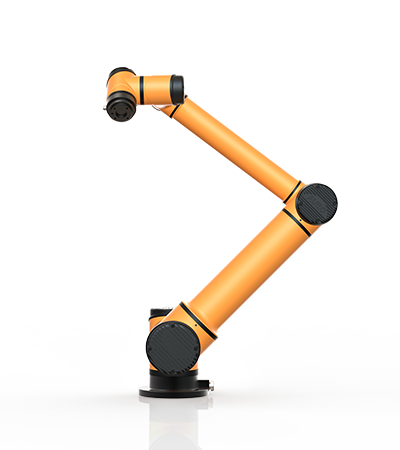
The AUBO-i12 carries 12 kg over 1250 mm, repeats to ±0.03 mm, weighs 40 kg and runs on the AUBO CB-M control box.
Main specification comparison
Specification | Universal Robots UR10e | AUBO-i12 |
Brand | Universal Robots | AUBO |
Listed price | $44,600 | $27,500 |
Payload | 12.5 kg | 12 kg |
Reach | 1300 mm | 1250 mm |
Repeatability | ±0.05 mm | ±0.03 mm |
Axes | 6 | 6 |
Speed | 120°/s (base, shoulder) and 180°/s (elbow, wrists) maximum joint speed | Not specified |
Arm weight | 33.5 kg | 40 kg |
IP rating | IP54 | Not specified |
Controller | UR control box CB 5.2 / CB 5.5 | AUBO CB-M control box |
Price comparison

UR10e: listed from $44,600
AUBO-i12: listed from $27,500
Difference: $17,100
The AUBO-i12 costs roughly 38% less
Payload and reach
The UR10e carries 12.5 kg over 1300 mm, half a kilogram and 50 mm more than the AUBO-i12. In practice both cover the same handling and machine tending layouts.
Precision

AUBO publishes ±0.03 mm repeatability for the i12, against ±0.05 mm for the UR10e, which favors precise placement and assembly.
Weight and sensing
The UR10e weighs 33.5 kg, about 6.5 kg less than the AUBO-i12, and has a built-in 100 N / 10 Nm force/torque sensor with 17 configurable safety functions.
Programming and connectivity
The UR10e runs PolyScope with hand-guided teaching and supports Modbus TCP, PROFINET and EtherNet/IP, with UR+ accessories.
AUBO publishes TCP/IP, Modbus RTU/TCP, PROFINET, digital and analog I/O, ROS support and SDKs for C/C++, C#, Lua and Python, which suits integrators and research teams that program in code.
Best applications for the UR10e

Force-controlled screwdriving and finishing
Mobile and column-mounted cells
Plants with existing UR cells
Best applications for the AUBO-i12
Budget-conscious handling and machine tending
Precise placement up to 12 kg
Custom software integration via SDKs
UR10e advantages
33.5 kg arm
Built-in force/torque sensor
UR+ ecosystem
UR10e limitations
About $17,100 higher listed price
±0.05 mm repeatability
AUBO-i12 advantages
About 38% lower listed price
±0.03 mm repeatability
Broad SDK and ROS support
AUBO-i12 limitations
40 kg arm
Final verdict
Choose the AUBO-i12 for value, precision and developer flexibility. Choose the UR10e for a lighter arm, force control and the UR+ ecosystem.
Both arms cover the same envelope, so either can serve the same cell layout.
Sources and further reading
Frequently asked questions
Which is cheaper, the UR10e or the AUBO-i12?
The AUBO-i12 is listed from $27,500 and the UR10e from $44,600, a difference of $17,100.
Which robot carries more?
The UR10e carries 12.5 kg and the AUBO-i12 12 kg.
Which robot has the longer reach?
The UR10e reaches 1300 mm and the AUBO-i12 1250 mm.
Which robot is more precise?
The AUBO-i12 publishes ±0.03 mm repeatability and the UR10e ±0.05 mm.
Which robot is lighter?
The UR10e weighs 33.5 kg and the AUBO-i12 40 kg.
Which robot should I buy?
Choose the AUBO-i12 for value and precision. Choose the UR10e for force control and a lighter arm.


