
Intrinsic Flowstate Review: Features and Uses of the Robotics Development Environment

Updated: 7 days ago
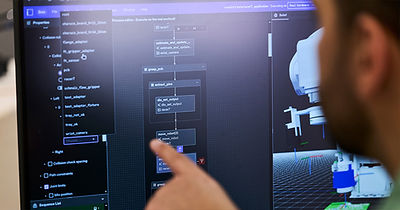
Intrinsic Flowstate is a software environment for designing, programming and deploying robot workcells. The manufacturer does not publish a price. This review covers its specifications, features and uses.
Quick Verdict
Flowstate comes from Intrinsic, an Alphabet company, and aims to make robot applications a matter of assembling software instead of writing each one from scratch. A developer builds a digital twin of the cell from a hardware catalogue or imported models, checks reach and collisions, and composes the process from skills, reusable building blocks such as moving a robot or estimating an object's pose. Skills are arranged in behavior trees that can include recovery from failures, through a graphical editor or a Python and C++ SDK. The process is run in simulation and then transferred to the real hardware. The page gives no list of supported robots, no figures and no prices; access is by demo request.
Intrinsic Flowstate at a Glance
Type: Developer environment for robotics
Workcell design: Digital twin; hardware catalogue or imported models
Checks: Reachability and collisions
Skills: From Intrinsic's catalogue or self-built
Process structure: Behavior trees with failure recovery
Price: on request
Intrinsic Flowstate Features
The table below lists what the manufacturer states.
Specification | Intrinsic Flowstate |
Manufacturer | Intrinsic |
Type | Developer environment for robotics |
Workcell design | Digital twin; hardware catalogue or imported models |
Checks | Reachability and collisions |
Skills | From Intrinsic's catalogue or self-built |
Process structure | Behavior trees with failure recovery |
Programming | Graphical UI; Python or C++ SDK |
Perception | Pose estimation, including trainable ML estimators |
Simulation | Run, visualize and debug on the digital twin |
Access | Demo request or trusted tester program |
Supported robot models, performance figures and prices are not stated on the page.
Design and Build Quality
The interface combines a 3D view of the cell with a process editor. The same solution runs in simulation and on the real cell.
Software and Integration
Skills
Skills can read sensors and control hardware and are shared between projects.
Sim to Real
A solution is moved from the twin to hardware and tested with a few clicks.
Intrinsic Flowstate Applications and Use Cases
Workcell Engineering
Designing and validating cells before building them.
Vision-Guided Tasks
Applications using pose estimation.
Reusable Automation
Building a library of skills across projects.
Intrinsic Flowstate Price and Value
Intrinsic does not publish pricing for Flowstate; access is through a demo request.
For the company behind the product, read the Intrinsic Company Profile: History, Ownership, Products and Partners.
Pros and Cons
Pros
Digital twin and deployment in one tool
Reusable skills
Behavior trees with recovery
Python and C++ SDK
Cons
Supported hardware not listed
No public pricing
Access by request
No published price
Who Should Buy the Intrinsic Flowstate?
It fits integrators and manufacturers with software teams who build many robot cells.
Intrinsic Flowstate FAQ
How much does the Intrinsic Flowstate cost?
Intrinsic does not publish pricing for Flowstate; access is through a demo request.
What is Intrinsic Flowstate?
A developer environment for building robotics solutions.
Who makes Flowstate?
Intrinsic.
What are skills in Flowstate?
Reusable building blocks that sense or control hardware, from a catalogue or self-built.
Does Flowstate include simulation?
Yes, on a digital twin of the workcell.
What languages does the Flowstate SDK support?
Python and C++.
How are processes structured in Flowstate?
As behavior trees, which can include failure recovery.
How do I get Flowstate?
Through a demo request or trusted tester program.
Specifications are based on manufacturer information and may change.


