
Unitree R1-7a Review: Specs, Price and Uses of the 7-Axis Bionic Robotic Arm

Updated: 7 days ago

The Unitree R1-7a is a 7-axis bionic robotic arm priced from $1,650. It is the arm of Unitree's R1 humanoid, sold as a separate product. This review covers its specifications, price and uses.
Quick Verdict
A seven-axis arm with force feedback for $1,650 is far below the usual price of such hardware. The R1-7a weighs 5.5 kg, carries 2 kg and reaches 650 mm with a dexterous hand. Unitree is open about the compromise: the joints use low reduction ratios, which makes them fast and back-drivable but limits positional stiffness, and the maker warns that positioning errors and oscillation can occur without well-tuned control. Repeatability is not stated. This is an arm for learning-based control and research, not for precise assembly.
Unitree R1-7a at a Glance
Degrees of freedom: 7
Weight: 5.5 kg
Payload: 2 kg
Max reach: 650 mm with dexterous hand
Supply voltage: 24 to 60 V
Price: from $1,650
Unitree R1-7a Technical Specifications
The table below lists the manufacturer's specifications.
Specification | Unitree R1-7a |
Manufacturer | Unitree Robotics |
Degrees of freedom | 7 |
Weight | 5.5 kg |
Payload | 2 kg |
Max reach | 650 mm, with dexterous hand |
Supply voltage | 24 to 60 V |
Interfaces | XT30 and CAN/485 |
User operating system | Ubuntu |
Control | Position and force control |
Force feedback and collision detection | Yes |
Joint speed | More than 180 degrees per second on all joints |
Price | From $1,650 |
Repeatability is not stated on the page.
Detailed Technical Data
J1: -156 to 156 degrees
J2: 0 to 180 degrees
J3: -20 to 200 degrees
J4: 0 to 180 degrees
J5: -130 to 130 degrees
J6: -30 to 30 degrees
J7: -90 to 90 degrees
Design and Build Quality
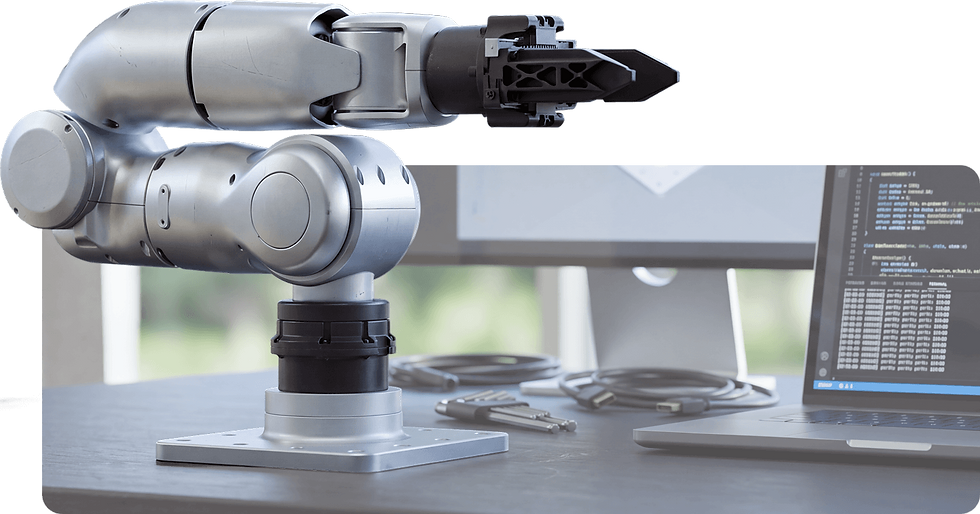
The arm follows the layout of a human arm, with three joint motor sizes along its length. End-effectors can be exchanged at the tip, including Unitree's dexterous hands. Unitree advises verifying the specifications by testing for each application, since testing standards for arms vary.
Programming and Software
Position and Force Control
Both modes are available through the control interface.
Collision Detection
Force feedback is used to detect contact.
Ubuntu
User software runs on Ubuntu.
Unitree R1-7a Applications and Use Cases
Embodied AI Research
Low cost allows several arms for data collection and learning.
Humanoid and Mobile Platforms
The 24 to 60 V supply suits battery-powered robots.
Education
Seven axes with force control at a classroom budget.
Unitree R1-7a Price and Value
Unitree lists the R1-7a from $1,650. End-effectors, taxes and shipping are additional. No other 7-axis arm with force feedback in this review series is priced near this level.
For the company behind the product, read the Unitree Robotics Company Profile: History, Products, Stock Listing and Controversies.
Pros and Cons
Pros
From $1,650
Seven axes
Force feedback and collision detection
Fast joints
Battery voltage supply
Cons
Limited positional stiffness, by the maker's own statement
Repeatability not stated
2 kg payload
Needs control expertise
Who Should Buy the Unitree R1-7a?
It fits laboratories and developers who train control policies and need many low-cost arms.
Unitree R1-7a FAQ
How much does the Unitree R1-7a cost?
From $1,650, according to Unitree.
How many axes does the Unitree R1-7a have?
Seven.
What is the payload of the Unitree R1-7a?
2 kg.
What is the reach of the Unitree R1-7a?
650 mm with a dexterous hand.
How much does the Unitree R1-7a weigh?
5.5 kg.
Does the Unitree R1-7a have force control?
Yes, with force feedback and collision detection.
Is the Unitree R1-7a precise?
Unitree warns that low reduction ratios limit positional stiffness; repeatability is not stated.
What power does the Unitree R1-7a need?
24 to 60 V.
Specifications are based on manufacturer information and may change.


