
Panasonic Bead Eye Review: Features and Uses of the AI Weld Bead Inspection System

Updated: 7 days ago

Panasonic Bead Eye lets a welding robot inspect its own welds after making them. The manufacturer does not publish a price. This review covers its specifications, features and uses.
Quick Verdict
Bead Eye replaces manual visual checks of welds. Two logics work together: a master comparison judges pass or fail against reference data and catches chipping, misplaced beads and wrong width or length, while a pre-trained Panasonic AI identifies perforation, pits, undercut and spatter and where they are. The AI cannot be retrained by users and inspects only straight arc welds. Internal defects and penetration cannot be seen. The spec table and precautions disagree on supported processes; the precautions limit it to CO2 and MAG with mild solid wire.
Panasonic Bead Eye at a Glance
Robots: TM, TL, TS, LA series
Logic 1: Master comparison, pass/fail
Logic 2: Pre-trained AI; defect type and position
AI detects: Perforation, pit, undercut, spatter
Master detects: Chipping, bead deviation, reinforcement, width and length
Price: on request
Panasonic Bead Eye Features
The table below lists what the manufacturer states.
Specification | Panasonic Bead Eye |
Manufacturer | Panasonic Connect |
Robots | TM, TL, TS, LA series |
Logic 1 | Master comparison, pass/fail |
Logic 2 | Pre-trained AI; defect type and position |
AI detects | Perforation, pit, undercut, spatter |
Master detects | Chipping, bead deviation, reinforcement, width and length |
Joints | Overlap fillet, T fillet, butt |
Not detectable | Internal defects, insufficient penetration |
The specification table lists MAG, MIG, TIG and laser, but the precautions limit inspection to CO2/MAG welding with mild solid wire. The AI inspects only linear beads.
Design and Build Quality
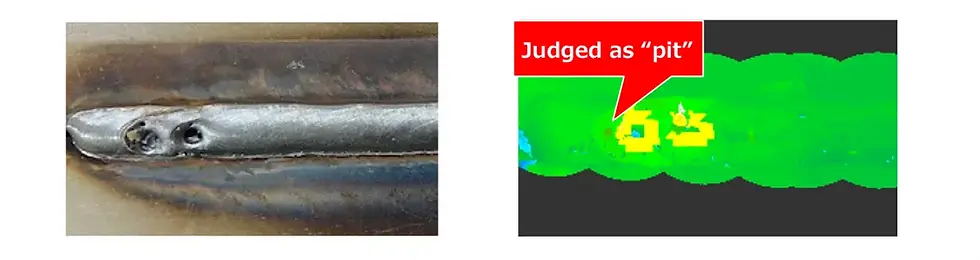
The system combines robot-mounted hardware with inspection software.
Software and Integration
Pre-Trained AI
Panasonic-trained; users cannot retrain it.
Traceability
Inspection data stored for each part.
Panasonic Bead Eye Applications and Use Cases
Automotive Welding
Seat frames and chassis parts.
Quality Assurance
Replacing visual checks.
Traceability
Recording weld quality.
Panasonic Bead Eye Price and Value
Panasonic does not publish a price for the Panasonic Bead Eye; it is quoted on request.
For the company behind the product, read the Panasonic Connect Company Profile: Structure, Businesses and Leadership.
Pros and Cons
Pros
Automates visual inspection
Finds defect types
Traceability
Robot-integrated
Cons
Linear beads only for AI
Cannot detect internal defects
Process support unclear
No published price
Who Should Buy the Panasonic Bead Eye?
It fits Panasonic welding users who want automated surface weld inspection.
Panasonic Bead Eye FAQ
How much does the Panasonic Bead Eye cost?
Panasonic does not publish a price for the Panasonic Bead Eye; it is quoted on request.
What is Panasonic Bead Eye?
A visual inspection system for weld beads.
Which robots does it work with?
Panasonic TM, TL, TS and LA series.
What defects can the AI find?
Perforation, pits, undercut and spatter.
Can users retrain the AI?
No.
Can it find internal defects?
No.
Which joints are supported?
Overlap fillet, T fillet and butt joints.
Does it support curved welds?
The AI inspects only linear beads.
Specifications are based on manufacturer information and may change.


