Kawasaki RS015X vs Nachi MZ25: Robot Comparison

Updated: 5 hours ago
IN A NUTSHELL
🔎 THE KEY DIFFERENCE This is a load-versus-reach trade-off: Nachi MZ25 has the higher stated load capacity, while Kawasaki RS015X has the longer stated reach. Start with the constraint your task actually has. |
→ CONSIDER Kawasaki RS015X Consider it when reaching farther matters more than the higher payload of the alternative. This article compares 15 kg and a 3,150 mm stated reach; include the gripper and part in the load. |
→ CONSIDER Nachi MZ25 Consider it when additional load capacity matters more than extra reach. This article compares 25 kg and a 1,882 mm stated reach; include the gripper and part in the load. |
💡 THE TAKEAWAY Choose the robot that handles your actual tool and part through the required path, with controls and support your team can use. Compare complete installation quotes, rather than arm-only prices. |

Kawasaki RS015X vs Nachi MZ25 is a choice about assembly and machine tending. Kawasaki RS015X and Nachi MZ25 differ in their working envelope, loading assumptions and engineering ecosystem. A useful decision starts with the exact mechanism and process, then checks whether either robot can execute the required path with the real tool attached. This comparison separates documented specifications from application-level engineering judgments.
Kawasaki RS015X vs Nachi MZ25: quick verdict
Shortlist Kawasaki RS015X for 15 kg industrial handling within the documented 3150 mm working reference. Shortlist Nachi MZ25 for 25 kg industrial handling within the documented 1882 mm working reference. Neither is a universal winner: a robot that can carry the load may still fail the fixture-access, controller or maintenance requirements.
The numerical comparison below uses Kawasaki RS015X against Nachi MZ25. The stated model scope matters when comparing later revisions or differently equipped installations. Published repeatability describes return to a taught position under specified conditions; it does not establish complete-cell accuracy or prove a faster production cycle.
Specifications and exact configuration scope
Criterion | Kawasaki RS015X | Nachi MZ25 |
|---|---|---|
Comparison configuration | Kawasaki RS015X | Nachi MZ25 |
Payload used for comparison | 15 kg | 25 kg |
Reach / motion-area reference | 3150 mm | 1882 mm |
Axes | 6 | 6 |
Repeatability for this scope | ±0.06 mm | ±0.05 mm |
Controller reference | F02 | FD20 |
Purchase-price basis | Configuration-specific quotation | Configuration-specific quotation |
Purchase pricing | From $52,800 (arm list price) | From $35,200 (arm list price) |
Read the reach row together with the geometric notes below. Manufacturers may specify an arm-link sum, a wrist-centre motion area or reach to the flange; those dimensions are not interchangeable. The table does not establish access to every point at every tool angle. Controller references identify reviewed packages, and actual compatibility must be confirmed by model, software version and region.
Kawasaki RS015X: design and configuration
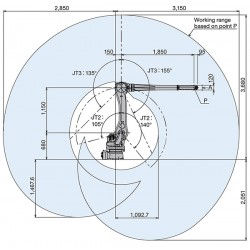
The Kawasaki RS015X is a 6-axis industrial robot with a 15 kg payload, a reach of 3150 mm and a positional repeatability of ±0.06 mm. It is a long-reach general-purpose robot used for material handling, machine tending and sealing across large work areas. The robot weighs 545 kg and runs on the Kawasaki F02 controller. Keep the exact suffix, controller generation, wrist load diagram and protection package in the order scope. A different family member’s reach, high-speed rating or controller options must not be transferred to this configuration.

Nachi MZ25: design and configuration
The Nachi MZ25 is a mid-size 6-axis industrial robot with a 25 kg payload, a reach of 1882 mm and a position repeatability of ±0.05 mm. Cables and air tubes run inside the arm through a hollow wrist, and the body has IP67-equivalent protection with coolant-resistant paint. It is used for machine loading, deburring, picking and assembly of larger parts. The arm weighs 250 kg and is designed for floor, angled or ceiling mounting, and it runs on the Nachi FD20 controller. The MZ25 runs on the FD20 controller and is programmed from the Nachi teach pendant. Nachi's FD on Desk software is available for offline programming and simulation. The controller, end effectors, safety equipment and integration affect the final price and are quoted separately. Prices are indicative, are not final and may change.
For this pair, Nachi MZ25 offers 25 kg over the stated 1882 mm reference, compared with 15 kg and 3150 mm for Kawasaki RS015X example. Kawasaki RS015X has the larger stated distance by 1268 mm, but this difference is only a preliminary layout indicator because reference points and joint envelopes can differ. Locate the actual fixture in each manufacturer model before treating this as usable extra working space.
Payload, tooling and a worked load example
Consider an illustrative total wrist load of 12 kg: a 3 kg tool and adapter package carrying a 9 kg part or product group. This arithmetic leaves 3 kg below the Kawasaki RS015X example’s nominal limit and 13 kg below Nachi MZ25’s nominal limit. These are mass differences, not safety factors or a validated load approval. A heavy camera, valve block or retained material must be included before recalculating the total.
The example exposes the practical question: is the application limited by mass, by tool offset or by wrist rotation? Kawasaki RS015X is the lower-or-equal nominal payload choice in this pair. Nachi MZ25 offers more or equal headline mass capacity, but that alone cannot approve an eccentric fixture. Moving the same mass farther from the flange increases the moment, and spreading it increases rotational inertia. Manufacturer load diagrams and the actual centre of gravity govern the final allowable motion.
Model the empty, partly loaded and fully loaded tool states separately. A vacuum layer gripper, a weld torch with hoses or an inspection head may change its effective loading during the cycle. Set the controller’s load data for each supported state and validate the transition logic. A payload table cannot predict acceleration derating, cable pull or transient reactions at a machine interface.
Reach, orientation and fixture access
Build the same cell model for both candidates: base height, machine opening, fixture datum, maximum part size, tool extension and access for maintenance. Kawasaki RS015X provides a stated 3150 mm reference, while Nachi MZ25 provides 1882 mm. Check the deepest production pose and the return path with the loaded tool. An arm that just touches the target at full extension may have little freedom left to turn, retract or avoid a door.
For assembly and machine tending, test the gripper jaws in their open and closed positions. Include feeder replenishment, rejected-part disposal and tool changes. Check wrist flips and singularity avoidance along the whole path. A compact robot can fit a small fixture well, while a longer arm can simplify station placement; neither geometric benefit can be assumed without the actual model.
Precision and throughput: compare the same task
The comparison uses ±0.06 mm for Kawasaki RS015X and ±0.05 mm for Nachi MZ25. These figures should be read in their documented configuration scope. Repeatability is not absolute accuracy, camera calibration accuracy or finished-part capability. Fixture variation, TCP calibration, thermal conditions and tool compliance can dominate the error at the process point, especially when the tool extends far from the flange.
Ask each integrator to execute the same representative path with the same payload model, tool length, process dwell and stop conditions. Report transfer time, settling time, process time and waiting time separately. Published standard cycles often use different loads and distances; dividing one catalogue cycle by another would not establish the production advantage of Kawasaki RS015X over Nachi MZ25. Use a measured or validated application cycle before assigning a throughput benefit.
Programming, controls and production integration
Kawasaki RS015X is paired here with F02, while Nachi MZ25 uses FD20. Controller names identify the review baseline rather than a guarantee that all interface options are included. Compare the actual software revision, teaching workflow, diagnostic tools, fieldbus licences and recovery procedures. An existing trained team and reusable production code may outweigh a small dimensional advantage. Obtain a demonstration of the same machine handshake and interrupted-cycle recovery on both platforms.
Specify the PLC handshakes before ordering: cycle request, ready, busy, complete, fault, part present and recovery authorization. Define how an interrupted operation resumes without repeating a dangerous or quality-critical action. Vision, force sensing, fieldbus communication and external-axis coordination must be checked as explicit included or optional functions. An Ethernet connector does not by itself prove that a particular industrial protocol or software interface is licensed and supported.
Configuration and communication detail
Integration reference | Kawasaki RS015X | Nachi MZ25 |
|---|---|---|
Control package | F02 | FD20 |
Documented interface baseline | Specify required interfaces in the delivered package | Specify required interfaces in the delivered package |
Programming baseline | Named platform software and supported API; confirm supplied version | Named platform software and supported API; confirm supplied version |
Integration acceptance | Test the actual machine handshake and controlled recovery | Test the same handshake and controlled recovery |
Protection, installation and maintenance
Match the precise protection package to the process. Standard, protected, cleanroom, foundry and washing configurations can have different seals, services and maintenance requirements. Do not transfer the best optional IP or cleanroom rating to an unprotected base model. Check the controller location, cable bend radius, available lifting access and base reactions with the installer.
Treat safe operation as a property of the complete task and installation. Include the tool, sharp workpiece edges, trapping points, dropped loads and machine access. These robot systems require task-specific safeguarding; payload or compact size does not establish safe unguarded operation. Plan tool replacement and fault recovery without dismantling the whole installation, and include connector access, lubrication and spare-cable replacement in the maintenance layout.
Price and lifecycle value
Published arm list prices: Kawasaki RS015X is listed from $52,800 and Nachi MZ25 is listed from $35,200. Request configuration-specific quotations for Kawasaki RS015X and Nachi MZ25. An arm-only number is not the price of a commissioned production cell. Ask for separate line items for controller, pendant, communication options, end effector, safety equipment, installation, acceptance, training and warranty. Price changes, regional support and included software can reverse an apparent hardware-cost advantage. Compare the same delivered scope before calculating payback.
Compare the installed production scope: tool, fixtures, sensing, guarding, machine interface, programming, acceptance and training. For small-parts automation, include feeders, vision calibration, nests and rejected-part handling. Keep purchase cost and recurring support costs separate. No payback figure is defensible until the actual cycle, yield, utilization and installation quotation are known.
Selection and acceptance plan
Decision gate | Kawasaki RS015X | Nachi MZ25 |
|---|---|---|
Strongest documented fit | 15 kg industrial handling within the documented 3150 mm working reference | 25 kg industrial handling within the documented 1882 mm working reference |
Main boundary | Tool mass, wrist moments and access constrain the headline specification. | Confirm exact configuration, controller, wrist loading and installation envelope. |
Required approval | Exact Kawasaki variant, tool load and validated process path | Exact competitor revision, tool load and validated process path |
Acceptance evidence | Agreed parts, path, quality and recovery results | The same agreed parts, path, quality and recovery results |
Advance Kawasaki RS015X when 15 kg industrial handling within the documented 3150 mm working reference solves the real constraint and its selected configuration passes the load and access checks. Advance Nachi MZ25 when 25 kg industrial handling within the documented 1882 mm working reference provides the more suitable process arrangement. Reject either candidate if a mandatory pose, protection requirement or controller function cannot be demonstrated. A purchasing shortlist should preserve these conditions instead of converting a single catalogue advantage into a blanket recommendation.
Before acceptance, agree the representative parts, tool states, operating sequence and quality criteria with both suppliers. Demonstrate cold start, normal production, rejected parts, interrupted cycles and controlled recovery. Record the final tool data and software backup. This turns the comparison into a repeatable purchasing decision and helps prevent a later fixture change from invalidating the original robot selection.
Motion architecture and functionality
Kawasaki RS015X has 6 arm axes and Nachi MZ25 has 6 arm axes. Both have six arm axes; equal axis counts do not establish equal joint travel, inner workspace or fixture access. Compare tool detection, sensing, machine I/O and recovery as separate delivered functions.
Industries and application fit
For Kawasaki RS015X vs Nachi MZ25, use the actual part and process as the industry filter. Electronics, manufactured-component handling and machine tending are candidate uses when their tool mass, access and quality requirements fit the documented configurations. These are application-selection judgments, not claims that either exact model is installed at a named customer. A food, medical-device or clean-production application additionally requires the correct material, lubrication and protection package; the base model name does not establish hygienic or cleanroom compliance.
Selection issue | Kawasaki RS015X | Nachi MZ25 |
|---|---|---|
Tool and workpiece mass | 15 kg named scope; include the complete tool | 25 kg named scope; include the complete tool |
Working reference | 3150 mm | 1882 mm |
Main configuration boundary | Tool mass, wrist moments and access constrain the headline specification. | Confirm exact configuration, controller, wrist loading and installation envelope. |
Process approval | Demonstrate the actual loaded path and recovery | Demonstrate the same loaded path and recovery |
Frequently asked questions
Which robot is better for this application?
Kawasaki RS015X is the stronger starting point for 15 kg industrial handling within the documented 3150 mm working reference, while Nachi MZ25 is worth shortlisting for 25 kg industrial handling within the documented 1882 mm working reference. The final choice depends on the real loaded path, required protection, controls and acceptance results. Neither a higher payload nor a longer reach establishes a universal winner.
What payload should I use for the comparison?
Use 15 kg for the specified Kawasaki RS015X example and 25 kg for Nachi MZ25, subject to all documented load and orientation conditions. Include the tool, adapters, sensors and carried part. Confirm exact configuration, controller, wrist loading and installation envelope.
Does the stated reach guarantee access to my fixture?
No. The comparison gives 3150 mm for Kawasaki RS015X and 1882 mm for Nachi MZ25 using the stated model references. Joint limits, reach reference points, wrist orientation, tool length and collisions determine whether the actual fixture is accessible. Simulate the full approach and exit path.
Can I use the best specifications from every family variant?
No. Keep each named model and revision intact. A different arm length, controller generation or protection option can change the relevant specification. Do not combine one version’s maximum payload with another version’s maximum reach.
Is repeatability the same as finished-part accuracy?
No. The stated values are ±0.06 mm for Kawasaki RS015X scope and ±0.05 mm for the competitor scope. Finished-part results also depend on fixtures, TCP calibration, sensing, thermal conditions and tool compliance. Validate the actual process instead of treating catalogue repeatability as a complete accuracy guarantee.
How should purchase prices be compared?
Use current written quotations for Kawasaki RS015X and Nachi MZ25 with the same arm, controller, software, tooling and commissioning scope. This comparison does not represent an ATC sales offer or stock confirmation. Historical review figures are not a substitute for a configuration-specific purchase quotation.
Can these robots operate safely next to people without guarding?
These specifications do not establish a safe unguarded installation. Assess the complete task, tool, load and machine interface, then implement and validate the required safeguarding and operating procedures. Do not infer collaborative operation from a compact arm, limited payload or education setting.
What should an acceptance test compare?
Use the same parts, actual tool load, fixture locations, path and quality criteria for Kawasaki RS015X and Nachi MZ25. Check production timing, settling, interruptions and recovery. Include the most difficult loaded approach and retreat. Approve the exact delivered configuration and preserve its final settings.
Related ATC reviews
Specifications describe the model scope identified above. Purchase pricing requires a current configuration-specific quotation. Confirm current manufacturer documentation, local supply, controller compatibility and the exact configuration before purchase.