
Bluepath Mouse/Tunnel High AMR Review: Specs, Uses, Pros & Cons

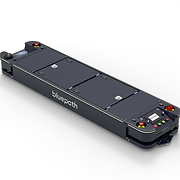
Bluepath Mouse/Tunnel High AMR review: Published towing/load class — 1,000 kg. Maximum speed — 1.5 m/s. This review examines the documented configuration, engineering tradeoffs and practical buying questions for this product.
Quick Verdict
A strong under-cart towing concept for constrained production routes. Its low profile and lateral maneuverability are useful when the cart coupling, loaded route and braking behavior have been engineered together.
Technical Specifications
Technical field | Documented configuration / buying implication |
|---|---|
Published towing/load class | 1,000 kg |
Maximum speed | 1.5 m/s |
Dimensions | 2,100 × 500 × 230 mm |
Robot mass | 450 kg |
Drive | Omnidirectional |
Navigation | Natural navigation and line tracking |
Engagement | Bidirectional pin system |
Position claim | ±1 cm |
Price | Request a configuration-specific quotation |
Design and Engineering Assessment
The 1,000 kg figure is a towing/load classification for the documented system, not permission to place an arbitrary one-ton load directly on the body. Bidirectional pin engagement can simplify approach directions, but positive coupling confirmation and cart geometry remain essential. Omnidirectional motion helps positioning while also requiring attention to lateral movement of the full cart envelope. A ±1 cm position claim is not a guaranteed mechanical pin tolerance under every floor and load condition. VDA 5050 compatibility needs version and mission-interface confirmation rather than an assumption of universal fleet interoperability.
Applications and Best-Fit Projects
Consider repeated under-cart transfers and towing between production stations where narrow access and flexible approach directions matter.
Tow-train design and route suitability
Treat the whole train as the moving system. Total mass, rolling resistance, wheel condition, couplers and slopes determine the towing demand. The last cart can off-track into space the tugger itself never occupies. Model the swept path at the tightest turn and test stopping with the longest approved loaded train. A headline tow rating does not establish performance on every floor or gradient.
Dispatch and station coordination
Define how carts are identified, coupled, released and confirmed at each stop. A milk run must balance delivery cadence against station space and the risk of carrying material past its destination. Automatic coupling or release needs positive confirmation. When a mission is interrupted, the fleet and inventory systems must agree which goods remain attached and which transfer has actually completed.
Operating cost and recovery
Include cart availability, charging, manual interventions and empty returns in the comparison. Test blocked aisles, a failed coupler and a cart with excessive drag. Manual takeover should be controlled and followed by a defined return-to-autonomy procedure. The most useful throughput measure is correct material delivered on time, including shift changes and normal exceptions.
Price, Value and What the Quote Should Include
Request a quotation for the exact configuration described in the technical table. Separate the base equipment from tooling, software options, installation, commissioning, training and ongoing service. Ask the supplier to identify the delivered revision and acceptance obligations in writing. A low hardware price is not a saving if the project requires unbudgeted integration or unsupported accessories.
For the value assessment, compare the present workflow with a realistic proposed cycle. Include the time people still spend loading, replenishing, checking quality and recovering faults. Estimate savings only from changes the proposed system can actually deliver. Keep maintenance, changeover and support availability in the calculation, and use a representative pilot to replace optimistic assumptions with measured results.
Pros and Cons
Strengths
• Omnidirectional movement
• Bidirectional pin engagement
• Natural and line-guided navigation
Limits to Account For
• Cart compatibility is essential
• Towing rating is route-dependent
Commissioning and Acceptance Checklist
Verify the actual cart/pin interface, rolling resistance, worst loaded lateral move, stopping distance and recovery after incomplete coupling.
Write the required result, test conditions and pass/fail threshold before running acceptance. Include the least favorable normal load or part, a representative shift or operating sequence and the recovery cases that occur in the real workflow. Keep a record of the supplied hardware, software and settings so future maintenance can restore the same validated behavior.
Who Should Consider It
Consider repeated under-cart transfers and towing between production stations where narrow access and flexible approach directions matter. A strong under-cart towing concept for constrained production routes. Its low profile and lateral maneuverability are useful when the cart coupling, loaded route and braking behavior have been engineered together.
Frequently Asked Questions
What are the best applications for Bluepath Mouse/Tunnel High AMR?
Consider repeated under-cart transfers and towing between production stations where narrow access and flexible approach directions matter.
Which technical specifications matter most for Bluepath Mouse/Tunnel High AMR?
The documented starting points are Published towing/load class: 1,000 kg; Maximum speed: 1.5 m/s; Dimensions: 2,100 × 500 × 230 mm. Match those values to one supplied configuration; do not combine family endpoints or assume an optional package is included.
How should Bluepath Mouse/Tunnel High AMR be integrated into a real workflow?
Treat the whole train as the moving system. Define the task boundaries, handoff signals and exception states before commissioning. Verify them with the actual tooling, carriers, fixtures or site data rather than a simplified demonstration.
What are the main limitations of Bluepath Mouse/Tunnel High AMR?
The main constraints are cart compatibility is essential; towing rating is route-dependent. The 1,000 kg figure is a towing/load classification for the documented system, not permission to place an arbitrary one-ton load directly on the body. Compare the complete installed solution against the process requirement rather than relying on a single headline figure.
How is Bluepath Mouse/Tunnel High AMR priced?
Request a configuration-specific quotation. A verified fixed public price for the complete package is not established here. The proposal should identify included hardware, required software, integration, training, service and any recurring charges so competing quotations cover the same scope.
Can Bluepath Mouse/Tunnel High AMR operate without human involvement?
Do not infer unattended reliability from a successful demonstration. Define which task steps are automated, which still require operators and how the system reacts to missing inputs, obstruction or process faults. Release only the validated operating envelope.
What should be tested before accepting Bluepath Mouse/Tunnel High AMR?
Verify the actual cart/pin interface, rolling resistance, worst loaded lateral move, stopping distance and recovery after incomplete coupling. Record measurable acceptance criteria and retain the results for the delivered configuration.
How should buyers compare Bluepath Mouse/Tunnel High AMR with alternatives?
Use the same task, quality target, operating conditions and support horizon for each proposal. Its low profile and lateral maneuverability are useful when the cart coupling, loaded route and braking behavior have been engineered together. Compare total installed and operating cost, including recovery effort and changeover, rather than robot-only price.
Specifications and included options depend on the ordered model and revision. Confirm the final configuration, commercial terms and local support with the supplier.


